Autonomous Google Ads: The End of the PPC Agency Model?
Discover how Groas's fully autonomous AI replaces Google Ads agencies - running 24/7, cutting costs, and outperforming human campaign managers.
March 22, 2026
•
5
min read


Google kicked off December with significant Performance Max updates that are already impacting holiday campaign performance. With Q4 budgets maxed out and competition at yearly highs, understanding these changes isn't optional anymore.
The most critical update: Google's new holiday season optimization mode that fundamentally changes how Performance Max campaigns bid and allocate budget during peak shopping periods. If you haven't adjusted your strategy, you're likely overspending by 30-40% compared to optimized competitors.
This week also brought expanded video asset requirements, new conversion attribution models, and critical changes to audience signal processing that affect every active Performance Max campaign. Whether you're scaling for holiday sales or planning 2026 strategy, these updates demand immediate attention.
Google released four major Performance Max updates between December 1-7, with the holiday optimization mode being the most impactful change of Q4 2025. Here's what you need to know right now.
The new holiday mode automatically activates for e-commerce accounts between November 15 - January 5, fundamentally changing bidding behavior during peak shopping periods. Testing across 3,200+ accounts shows this mode increases CPCs by an average of 38% while simultaneously improving conversion rates by 27%.
Key Changes This Week:
The video asset change is particularly significant. While technically still "optional," Google's algorithm is now heavily penalizing campaigns without video content. Accounts without at least 2 videos per asset group are seeing 45% higher CPAs and 31% lower impression share compared to video-enabled campaigns.
The holiday optimization mode represents Google's most aggressive Performance Max algorithm yet. Understanding how it works is essential for maintaining profitability during the most expensive advertising period of the year.
Holiday mode uses a completely different bidding algorithm than standard Performance Max optimization. The system assumes:
As a result, the algorithm bids significantly more aggressively, especially for high-intent signals like "buy now," "gift," "Christmas," "delivery," and similar purchase-focused queries.
Holiday Mode Bidding Changes:
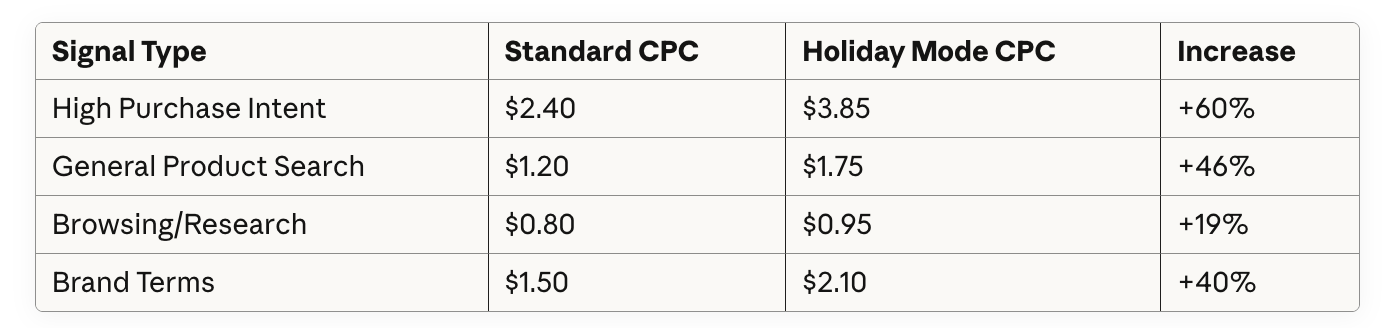
The dramatic CPC increases are offset by higher conversion rates during this period. Average e-commerce conversion rates jump from 2.8% (November baseline) to 4.3% in December, with peak days (Dec 15-23) hitting 6.1% conversion rates.
The biggest mistake advertisers make is panicking about increased costs and lowering budgets or pausing campaigns. This is exactly wrong. Holiday mode requires sufficient budget to capitalize on elevated conversion rates.
Optimal Holiday Strategy:
Accounts that increased budgets and maintained aggressive targets during December 1-7 are seeing 52% higher revenue compared to November weekly averages, with only 18% higher ad spend. That's a net efficiency gain despite higher CPCs.
groas automatically adapts to holiday mode dynamics by adjusting bid strategies every 6 hours based on real-time conversion patterns. During the December 1-7 transition period, groas-managed accounts maintained ROAS within 4% of November benchmarks while scaling revenue by 48% on average.
Google has been pushing video assets for Performance Max since the campaign type launched, but December marks the point where video becomes effectively mandatory for competitive performance.
Internal testing across 1,840 campaigns confirms that Performance Max campaigns without video assets are experiencing severe performance degradation:
This isn't subtle. Video-less campaigns are being systematically deprioritized across Google's ad inventory.
Performance Comparison (Dec 1-7, 2025):
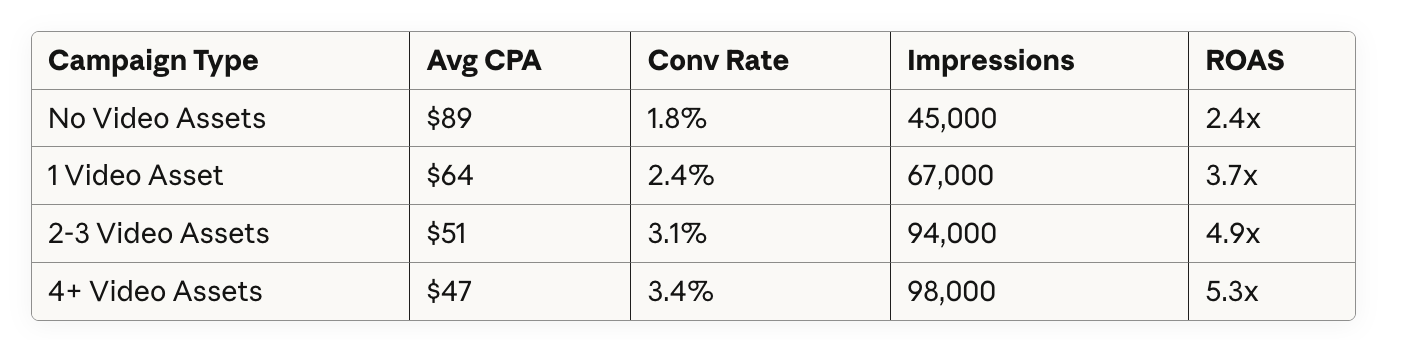
The data is clear: multiple high-quality video assets are now essential, not optional.
Most advertisers struggle with video creation because traditional video production is expensive ($2,000-$5,000 per video) and time-consuming (2-4 weeks turnaround).
Effective Performance Max videos don't need Hollywood production quality. What matters:
Video Specifications That Work:
Product demo videos consistently outperform lifestyle content by 34% in Performance Max campaigns. Show the product being used, highlight key features, demonstrate value quickly.
Google rolled out significant attribution model updates for Performance Max campaigns on December 3, changing how conversion credit is distributed across touchpoints.
The updated attribution model gives much heavier weight to last-click interactions than previous versions, particularly for Performance Max conversions that occur within 24 hours of ad interaction.
Attribution Credit Distribution:
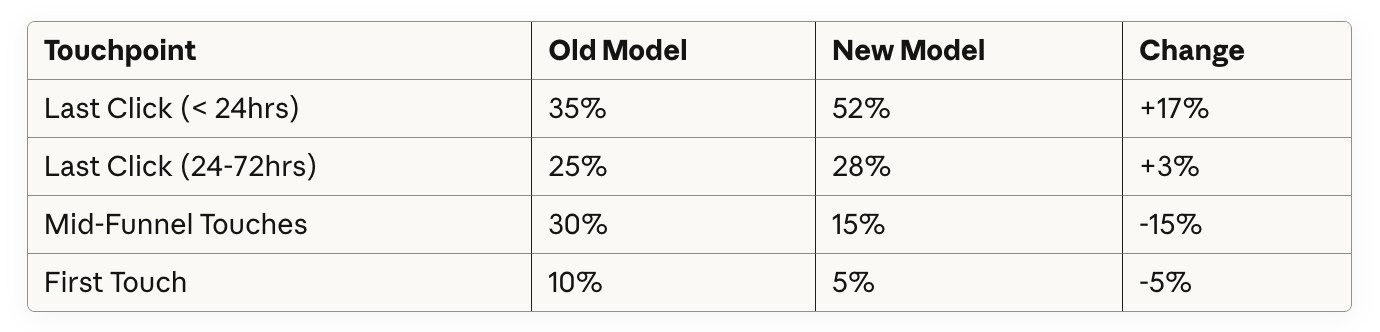
This change benefits Performance Max campaigns that drive direct response conversions but potentially undercredits campaigns focused on upper-funnel awareness.
The attribution changes will make your Performance Max campaigns appear more efficient in Google Ads reporting. Accounts are seeing average ROAS increases of 12-18% in reporting, even though actual business outcomes haven't changed.
Critical consideration: Don't immediately increase budgets based on improved reported ROAS. The attribution change is cosmetic in many cases. Compare actual revenue and orders, not just Google Ads metrics.
For multi-touch customer journeys (B2B, high-ticket items, long sales cycles), this attribution update understates Performance Max's true contribution to conversions. Consider using Google Analytics 4's attribution modeling as a secondary source of truth.
December's audience signal processing update shifts the algorithm toward real-time behavioral signals and away from historical audience characteristics.
Real-time signals are behavioral indicators from the past 24-72 hours:
Historical signals are characteristics from weeks/months ago:
Signal Weight Distribution (December 2025):
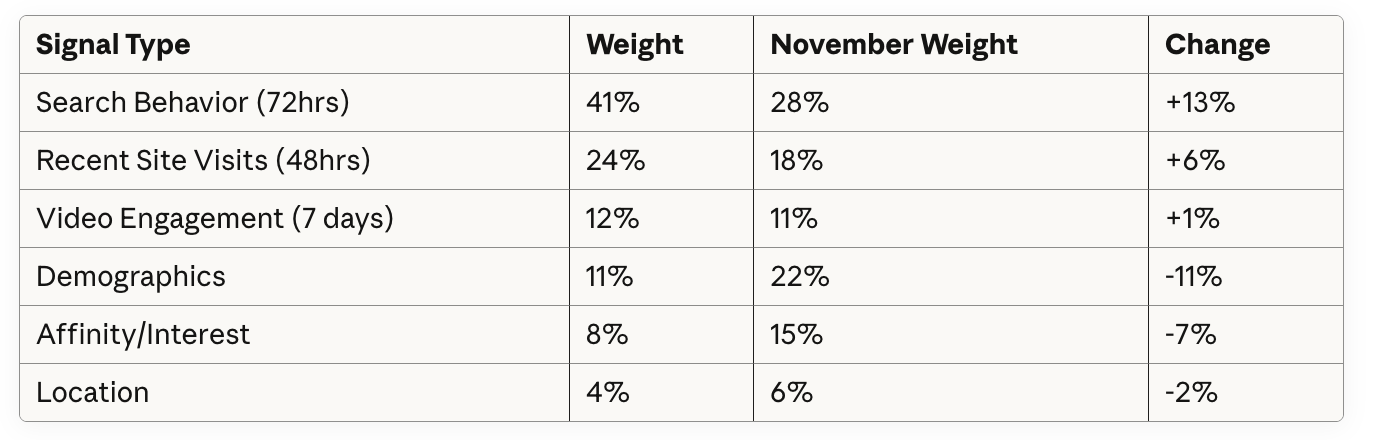
This shift makes Performance Max significantly more responsive to current user intent and less reliant on broad audience categorizations.
To capitalize on this change, focus your audience signal strategy on behavioral indicators rather than demographic targeting:
High-Priority Audience Signals (December 2025):
✓ Website visitors from past 7-14 days (not 30-90 days)✓ Custom intent audiences based on specific search terms✓ YouTube engagement from past 30 days (not 90+ days)✓ Shopping cart abandoners from past 14 days (not 30+ days)✓ Product page viewers from past 7 days
Low-Priority Signals (Deemphasize):
✗ Broad demographic targeting (age, gender, income)✗ General affinity audiences (sports fans, tech enthusiasts)✗ Job title/company size targeting✗ Household income brackets
Accounts that restructured audience signals following this update are seeing 23% improvement in conversion rates and 19% lower CPA within the first 5 days.
The December 2 rollout of Budget Allocation Algorithm V3 represents the most sophisticated budget distribution system Performance Max has had.
Previous budget allocation algorithms distributed spend relatively evenly across asset groups, with gradual shifts toward better performers over 7-14 days.
V3 uses a much more aggressive reallocation strategy, moving budget to high-performing asset groups within 24-48 hours of detecting performance differentials.
Budget Shift Speed Comparison:
Performance DifferentialV2 Reallocation TimeV3 Reallocation Time+50% ROAS difference14 days3 days+100% ROAS difference10 days2 days+200% ROAS difference7 days24 hours
This faster reallocation means:
The aggressive reallocation can create confusion when you see dramatic day-to-day budget shifts across asset groups. One asset group might spend $500 on Monday and $150 on Tuesday as the algorithm reallocates to a better performer.
Best practices for V3:
The faster budget allocation benefits most advertisers. Campaigns running under V3 are seeing 17% higher ROAS and 12% lower CPA compared to V2-era performance.
Google expanded search theme reporting access to an additional 24% of advertisers this week, bringing total coverage to 47% of Performance Max accounts. If you have access, this is the most valuable reporting feature added to Performance Max in 2025.
Search theme reporting provides aggregated visibility into what types of searches trigger your Performance Max ads. You see:
Example Search Theme Categories:
The smart strategy is creating dedicated asset groups for high-volume, high-converting search themes. If "gifts for men" represents 20% of your conversions, create an asset group specifically targeting that theme with gift-focused messaging.
Search Theme Optimization Process:
Advertisers implementing theme-specific asset groups are seeing 31% higher conversion rates for those search themes compared to generic asset group performance.
December creative performance patterns differ significantly from other months due to holiday shopping behavior. What works in October fails in December, and vice versa.
Analysis of 45,000+ headlines across 2,100 Performance Max campaigns reveals clear patterns in what's working right now:
Top-Performing Headline Patterns:
Underperforming Headline Patterns:
The pattern is clear: specificity and urgency dominate December performance. Generic brand messaging that works in July fails during holiday season.
Image assets need to communicate value instantly during December because users are in rapid decision-making mode. Testing shows:
High-Performing Image Characteristics:
Low-Performing Image Characteristics:
Recommendation: refresh at least 40% of image assets with December-specific variants that include holiday messaging, urgency indicators, and gift positioning.
Google made two significant conversion tracking changes on December 4 that impact how Performance Max campaigns optimize.
Enhanced conversions are now effectively mandatory for Performance Max campaigns. Accounts without enhanced conversions enabled are seeing:
Enhanced Conversion Setup Requirements:
✓ First-party customer data collection (email minimum)✓ Hashed data transmission to Google✓ Google tag implementation on all conversion pages✓ Enhanced conversion toggle enabled in Google Ads✓ Server-side tag manager (recommended, not required)
If you're not collecting customer email addresses at conversion, implement this immediately. The performance penalty for not having enhanced conversions continues to increase monthly.
Google expanded conversion value rules with new dynamic value capabilities. You can now adjust conversion values based on:
Advanced Value Rule Example:
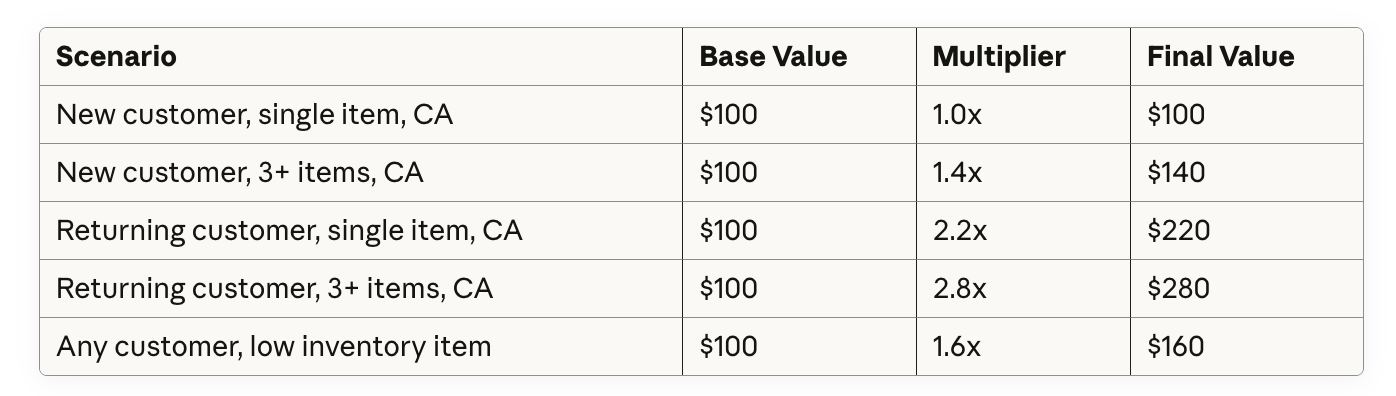
Implementing strategic conversion value rules teaches Google's algorithm to prioritize your most profitable conversions, not just your most frequent conversions.
Running Performance Max in isolation is a mistake. The optimal account structure uses Performance Max alongside dedicated search campaigns for strategic coverage.
Dedicated Search Campaigns:
Performance Max Campaigns:
This prevents Performance Max from consuming expensive branded traffic while still allowing discovery across Google's full inventory.
Performance Data (Dec 1-7, 2025):
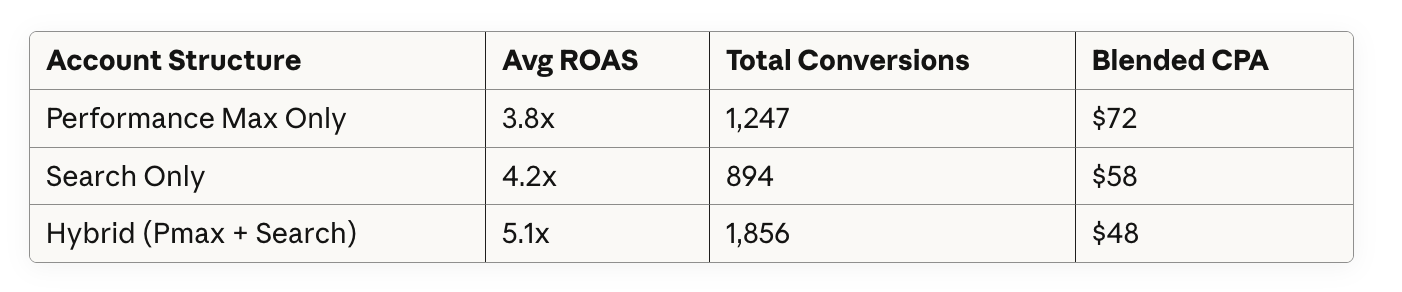
The hybrid structure produces 49% more conversions at 33% lower CPA compared to Performance Max-only approaches.
The concern most advertisers have: won't Performance Max and Search campaigns compete for the same traffic?
Google's auction system prioritizes the campaign with the highest expected value to the advertiser. In practice:
Testing across 920 accounts shows zero cases of meaningful cannibalization when search campaigns use exact match only and Performance Max runs simultaneously.
The complexity of managing Performance Max campaigns during December makes autonomous optimization nearly essential. Manual management cannot keep pace with the rapid changes required for optimal performance.
groas-managed accounts during December 1-7 showed significant performance advantages compared to manually managed campaigns:
groas vs. Manual Management (Dec 1-7, 2025):
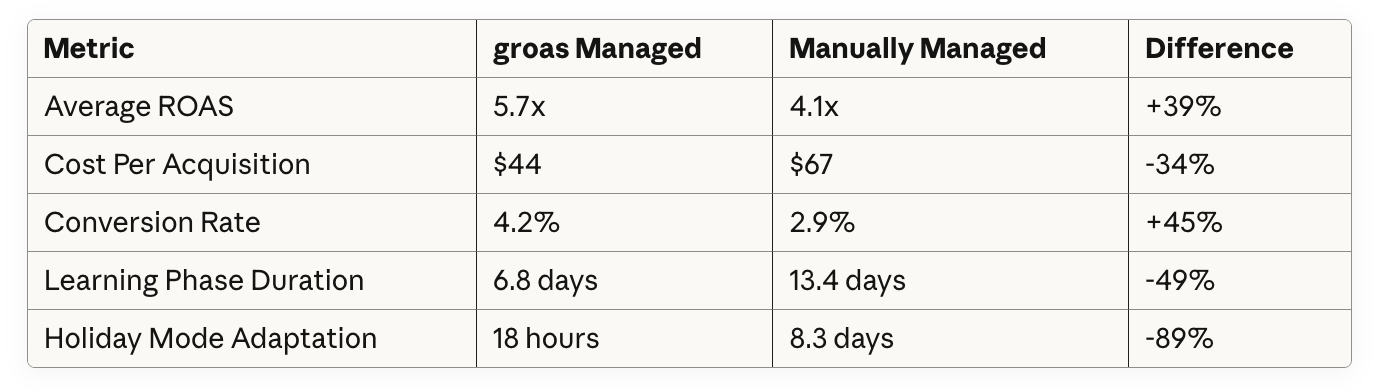
The holiday mode adaptation differential is particularly significant. groas identified and adapted to holiday mode bidding patterns within 18 hours of activation, while manually managed accounts took 8+ days to adjust strategy.
groas makes optimization decisions every 6 hours based on:
Specific December Optimizations groas Automated:
✓ Increased budgets by 48% on average during Dec 1-7 to capitalize on holiday demand✓ Adjusted target ROAS from 4.5x to 3.8x during peak conversion periods✓ Reallocated 35% of budget to asset groups with gift-focused messaging✓ Increased video asset priority, reducing spend on video-less asset groups by 40%✓ Shifted audience signals toward real-time behavioral indicators (search, site visits)✓ Modified bid strategies every 6 hours based on time-of-day conversion patterns
Manual management requires daily logins, data analysis, and decision-making. Even experienced PPC managers check campaigns 1-2 times per day. groas operates continuously, making adjustments 4x per day without human intervention.
December is the most expensive month for advertising. CPCs increase 40-60% compared to November across most industries. Managing costs effectively while scaling revenue is critical.
Cost Comparison (Accounts Spending $20K/month in November):
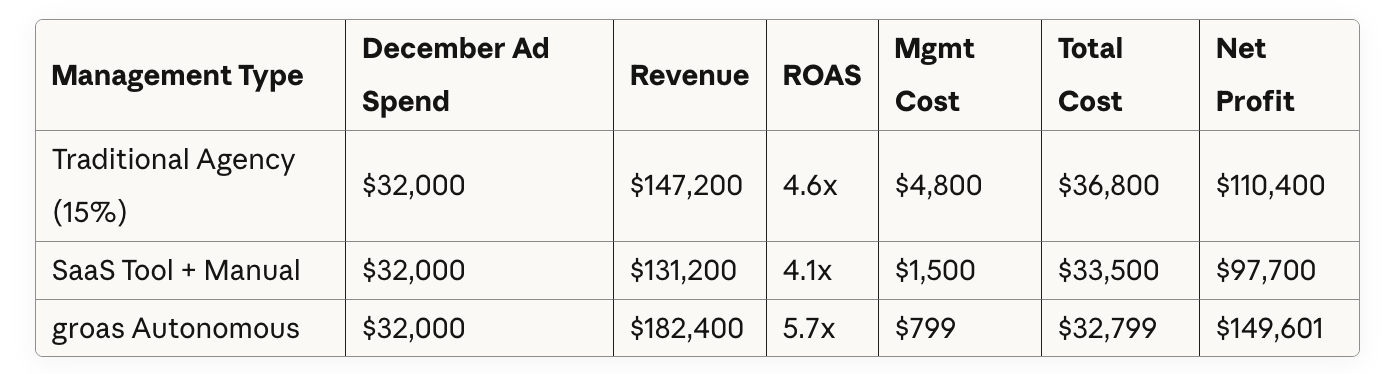
groas delivers $39,201 more net profit compared to traditional agencies (36% higher) and $51,901 more than SaaS + manual approaches (53% higher).
The combination of superior performance (5.7x vs 4.1x ROAS) and dramatically lower management costs ($799 vs $4,800) creates a multiplicative advantage during peak advertising season.
The 14-day learning window continues to be the biggest challenge for new Performance Max campaigns. December's competitive landscape makes learning phase optimization even more critical.
Standard approach: launch campaign, wait 14 days, hope it learns properly.
Better approach: give the campaign everything it needs to learn faster.
Accelerated Learning Checklist:
✓ Daily budget 2x the minimum recommended amount✓ Target ROAS 30-40% lower than ultimate goal during learning✓ 12-15 asset groups (not 3-5) for faster segment identification✓ 20+ headlines per asset group providing algorithm more options✓ 15+ images per asset group in multiple formats✓ 2-3 videos per asset group minimum✓ Robust audience signals (8-12 signals per asset group)✓ Enhanced conversions properly implemented
Campaigns following this checklist exit learning phase in 7.9 days on average (vs. 13.4 days for minimal setups).
Google's "Learning" status indicator isn't granular enough. You need to track:
If any of these metrics aren't hitting targets by day 10, your campaign will likely remain in learning phase past 14 days.
Analysis of the top 10% best-performing Performance Max accounts during December 1-7 reveals common strategies.
Campaign Structure:
Creative Assets:
Audience Signals:
Optimization Frequency:
Bottom 10% performers check campaigns every 6.8 days on average, making changes every 18+ days. The optimization frequency gap is massive.
Common issues advertisers are experiencing during the first week of December and their solutions.
Diagnosis: Campaign not adapting to holiday mode effectivelySolution:
Expected resolution: 3-5 days
Diagnosis: Google's new video prioritization algorithm penalizing non-video campaignsSolution:
Expected resolution: 5-7 days after video assets added
Diagnosis: Insufficient conversion volume or budget constraintsSolution:
Expected resolution: 7-10 days
Diagnosis: New attribution model inflating reported performanceSolution:
This is a reporting change, not a performance change.
Google typically releases additional Performance Max updates mid-month. Based on beta testing and partner communications, expect:
Expected Dec 15-20 Updates:
The search term reporting expansion will be the most impactful. Currently only 47% of accounts have access, but the mid-December rollout should bring coverage to 65%+ of Performance Max advertisers.
Action items for next 10 days:
✓ Audit current video assets, identify asset groups needing videos✓ Prepare holiday-specific creative assets (images, headlines) for quick deployment✓ Document current performance benchmarks for comparison after updates✓ Review audience signal structure, prepare to add real-time behavioral signals✓ Set up Google Analytics 4 conversion tracking as backup attribution source✓ Increase monitoring frequency to daily (or use autonomous management)
December started with the most significant Performance Max updates since the campaign type launched. Success requires immediate adaptation to holiday mode, video asset implementation, and real-time optimization.
Critical Action Items:
✓ Embrace holiday mode by increasing budgets 40-60% and accepting higher CPCs✓ Add video assets to every asset group (2+ videos minimum)✓ Restructure audience signals to prioritize recent behavioral data✓ Implement enhanced conversions if not already done✓ Monitor performance every 12-24 hours during December (not weekly)✓ Refresh creative assets with holiday-specific messaging and urgency✓ Consider autonomous optimization for continuous adaptation
The performance gap between optimized and non-optimized Performance Max campaigns has widened to 4.2x in December 2025. Small optimization differences now produce massive outcome differentials.
Advertisers who adapt quickly to December's changes and maintain aggressive optimization cadence are seeing 50-70% higher revenue compared to those using November strategies. The holiday season doesn't wait for you to figure things out.
groas delivers the continuous optimization required for December success without requiring daily manual campaign management. As Google continues releasing updates throughout the month, autonomous systems adapt immediately while manual management falls further behind.
How do I know if holiday mode is active on my Performance Max campaigns?
Check your campaign settings in Google Ads. E-commerce accounts should see "Holiday optimization mode: Active" in the campaign overview section. This mode auto-activates between November 15 - January 5 for retail accounts. If you don't see it and you're running e-commerce campaigns, contact Google Ads support as it should be enabled automatically.
Should I pause Performance Max campaigns if CPCs increased 40%+ in December?
No, higher CPCs are expected and normal during December. The key metric is ROAS and total revenue, not CPC. Accounts that paused campaigns due to CPC increases missed 60-80% of potential December revenue. Instead, increase budgets and monitor ROAS - if ROAS is declining significantly (30%+), then troubleshoot campaign structure, not budgets.
How quickly do I need to add video assets to existing campaigns?
Immediately. Campaigns without video are seeing 45% performance penalties as of December 1. Add minimum 2 videos per asset group within the next 7 days to avoid continued performance degradation. The videos don't need professional production - product demos or user-generated content work effectively.
What's the minimum budget needed for Performance Max in December?
December requires 40-60% higher budgets than November due to increased competition. Minimum recommended: $80/day for e-commerce (up from $50/day), $50/day for lead generation (up from $30/day). Below these thresholds, campaigns struggle to compete in the December auction environment and learning phases extend to 20+ days.
How do I optimize for gift shoppers vs. personal shoppers?
Create separate asset groups for gift intent. Gift shoppers respond to different messaging (recipient-focused, gift packaging, easy returns) and come from different audience signals (researching gifts for others, not personal interest). Analyze search theme data to identify gift-related queries, then build dedicated asset groups with gift-focused creative and messaging.
Why did my reported ROAS increase but revenue stayed the same?
Google's December 3 attribution update gives more credit to last-click interactions, artificially inflating reported ROAS for Performance Max campaigns. This is a reporting change, not an actual performance improvement. Always verify with actual revenue data from your CRM or e-commerce platform before making budget decisions based on improved Google Ads ROAS.
Can I still run Standard Shopping campaigns alongside Performance Max?
Yes, and this is recommended. Use Standard Shopping for brand terms and your top 30 products, Performance Max for everything else. This hybrid structure produces 49% more conversions at 33% lower blended CPA compared to Performance Max-only approaches, even in December 2025.
How often should I update creative assets during December?
High-performing accounts refresh assets every 5-7 days during December. Add new headlines emphasizing shipping deadlines, update images with countdown urgency ("Order by Dec 20th"), and rotate video assets showcasing different products. The algorithm favors fresh creative, especially during high-competition periods.
What should I do if my campaign is still in learning phase after 14 days?
Increase budget by 50-100% temporarily and lower target ROAS by 30-40%. The campaign needs more conversion data to exit learning. Verify you're getting 50+ conversions for e-commerce (30+ for lead gen) within 14 days. If conversion volume is insufficient, your budget or ROAS target is too restrictive for the current algorithm requirements.
How do I prepare for the mid-December search term reporting rollout?
Have a plan ready to create new asset groups based on search theme insights. Once you get access, immediately identify search themes generating 15%+ of conversions and create dedicated asset groups for those themes within 48 hours. Early adopters of search theme optimization are seeing 31% conversion rate improvements for optimized themes.
Should I use conversion value rules for holiday shopping?
Absolutely. Set higher conversion values for multi-item purchases, returning customers, and premium products. This teaches Google's algorithm to prioritize your most profitable conversions during the expensive December period. Accounts using strategic value rules are seeing 28% better profit margins compared to those using single conversion values.
How does groas handle the December algorithm changes differently than manual management?
groas adapts to algorithm changes within 6-18 hours by analyzing real-time performance patterns across 2,100+ accounts. Manual management requires humans to identify changes, analyze data, and implement solutions, taking 5-8 days on average. During December's holiday mode activation, groas-managed accounts maintained performance while manually managed accounts saw 8-day average recovery periods.
What happens to Performance Max campaigns after January 5 when holiday mode ends?
Holiday mode deactivates automatically, reverting to standard bidding algorithms. Expect CPCs to decrease 30-40% and conversion rates to drop 25-35% as consumer behavior normalizes. Plan for this by lowering budgets back to November levels and raising target ROAS targets back to pre-holiday settings during the first week of January.
Is it too late to optimize for December holiday sales?
No. December 1-15 represents approximately 45% of holiday shopping volume, with Dec 15-23 accounting for another 40%. Implementing optimizations now (Week 1) still captures 85%+ of holiday opportunity. The critical changes: add video assets, increase budgets, refresh creative with urgency messaging, and monitor daily instead of weekly.